Wednesday, February 22, 2017

RECYCLE

"You really should turn this idea into a feature."

Every writer has their favorite story, the one they spend months or even years developing, the one they still get a kick out of every time they read it. It's even better when others read it and fall in love with it too. But it's incredibly frustrating when the screenplay isn't optioned and ends up gathering cyber dust on the hard drive of your computer. Don't despair, no project is ever truly dead.

A screenwriting friend once described projects as roundabouts; eventually, they'll come around again. What he meant by this is that someone somewhere at some time in the future will be interested in that project and option it. It may not be today, tomorrow, or even next month, but at some point, the subject of your screenplay will suddenly be in vogue again. "Have you got anything with happy dancing, pensioner gnomes in it?"

That's why it's always worth revisiting your work now and again and bringing it up to date, so it's ready to go should the market change in its favour.

Then there's recycling your ideas. In a meeting with a TV company last month I was told they loved the sample of work I sent them, a pilot episode of a spec TV crime drama series. When they suggested the idea would make a brilliant feature I initially dismissed the idea. But the more I thought about it the more it actually made sense.

It's not the first time I've changed the medium of one of my projects. One of the features I was commissioned for has changed from British Drama to American Crime Thriller to British TV Crime Drama. The idea has been recycled, turned into something else, giving it more chances of being
made.

So go and take look at your work and see if any of it could translate to another medium, whether that be a feature, a radio play, a piece of theatre or even a novel.

Happy writing!

Wednesday, February 01, 2017

LONDON, MEETINGS AND POTS OF TEA

Because I live on the busy South Coast of the UK it takes between two and three hours (depending on whether it's the fast or slow train) to travel up to London for meetings, which usually means a whole day away from my desk. So when I do travel up I like to make sure I have a packed day ahead of me.

I arrived at Waterloo at 10.00am yesterday, ready and raring to go. My agent was waiting for me under the clock and we hurried off to find a cafe, desperately dodging rain showers as we negotiated the London traffic. It was just a brief catch up over a latte before heading off for the main meeting of the day, discussing what I planned to write over the next few months and the various stages my current projects were at. And good news, my agent loved my new spec drama pilot episode and the series bible for a new crime drama idea. So after agreeing on a strategy for sending them out, I hopped on the tube for my next meeting.

It was cold and wet, so I was glad the lady emailed me to let me know she was already at the agreed meeting place and waiting for me inside. No standing outside in the rain like a lemon for me.

This was the big one, the reason for my trip, a major TV production company with offices all over the world and they wanted to meet with little old me. No pressure then... HA! In fact, it was a very relaxed chat. I sat down, ordered a pot of tea, she discussed how their company works, what they are looking for and what they are currently working on. Then we discussed my projects and I agreed to send her three of them. A great meeting. But after the latte and the pot of tea (Breakfast tea, three full cups) the pressure was starting to build, so I had to make a pit stop and grab a sandwich to go on the way to my next meeting with the brilliant Phil Mulryne, script editor of Doctor Foster series two.

Our meeting was just a little catch-up, two people with a love of TV and screenwriting chatting about what they were up to and what they were currently loving on the goggle box. It's always good to keep in touch with people and keep abreast of what they're working on. Another pot of tea later (this time lemon and ginger, another three cups) I scurried off to my final meeting of the day with my good friend Tom Kerevan... and he bought me a large latte.

The trains were delayed on the way home. Two people had been hit by trains in separate incidents. A lot of services had been cancelled and were only just getting up and running again. It was chaos. A lot of people were angry and could only see the two suicides as an inconvenience. It saddened me that our race can be so uncaring at times.

As I waited patiently for my train I thought about those two unfortunate souls, who for whatever reason had decided their lives were not worth living. I realised I'm a very lucky person to do what I love, to have others who love what I do and to be surrounded by those who love and support me.

So as I sat on the crowded train home, my bladder full to bursting, I said a little prayer for those two lost souls and promised myself to always be grateful for the opportunities presented to me.

Happy writing.

Wednesday, January 11, 2017

HARVESTING THE BUZZ

There are moments in life that are just so amazing they leave you with a buzz, that feeling you're on fire and everything is right with the world. For writers, especially those starting out, those moments can be few and far between. It's important to make the most of them, to use them to help keep you going through the lean times. But how?

I went up to London yesterday for a general meeting with a production company whose dramas I've been a fan of for many years. The meeting went extremely well. On the way home I was worried the high I was experiencing would evaporate after a few hours and the motivation it created would be diminished. I began to wonder if there was a way to harvest the buzz I was feeling to use another day when the doldrums were upon me. In the past, I've kept a feedback folder, where I used to put all those lovely emails of praise to refer to when I needed. I have no idea where it is today, probably somewhere in the black hole that is my office cupboard, tucked somewhere at the back and now home to a family of spiders.

So what could I do? It was an idea of my wife's that helped to provide the solution.

A jar full of goodness.
A couple of years ago my wife Susie told me about an idea called the Gratitude Jar. She kept a jar in the kitchen and instructed me and the boys to write down anything that happened that we were grateful for and put it in the jar. Then on New Years Day we would open the jar and reflect on all the great things that had happened to us as a family over the previous twelve months. But as usual with these things we did it for a few weeks and eventually forgot about it.

As the South-West train zoomed through the countryside to Poole I thought, "Why can't I use a Gratitude Jar to keep a track of all my highs as a writer, so they're there when I need them the most?" So I've nicked one of my wife's empty jars she was saving up to make jam with and I've put it on my desk where it will be in view every time I sit down to work. When something good happens I'll write it down on a Post-it Note and pop it in the jar. By the picture, you can probably tell there are three BUZZes in there already. January is already proving to be an awesome month.

The next time I'm in a slump I'm going to grab that jar, pulls out some of those BUZZes, read them and perk myself up. You might like to try it too.

Happy writing!

Wednesday, January 04, 2017

THE YEAR THAT WAS AND THE YEAR THAT WILL BE

2016 was a roller coaster of a year. There were ups and downs, twists and turns and at a couple of points I felt so sick I wanted to get off. I didn't though, I stayed on board until the bitter end. I'm glad I did, because late November early December everything flipped upside down.

But before I get to that, let me tell you more about my 2016.

THE LOWS - Every writer experiences them, even the well known and well paid ones. That brilliant idea you love gets rejected by everyone you send it to even though they love it, the promise of work never materialises and you constantly find yourself butting your head against dead ends.

I had a couple of really big slumps during the year and found myself questioning whether I should quit and go and find something more stable to do instead. I didn't of course, I never do, it's just not in may nature to walk away when things get tough. Successful writers are resilient buggers and besides, the highs would be nothing without the lows. So after each slump I sulked for a couple of hours, took a week off to do wonderful non writing related stuff and then went back to things refreshed, with a renewed optimism and enthusiasm.

Disappointment is inevitable, so if you want to be successful make sure you brush it aside as quickly as you can and carry on. You just never know what's waiting around the corner for you.


THE HIGHS - They fell in to three categories; 'Well That Was Nice', 'Flippin' 'Eck That's Awesome' and 'Mind Blowingly Epic'!

Here are just a few of the 'Well That Was Nice' and 'Flippin' 'Eck That's Awesome' highs that happened over 2016 - I finally found the time to finish two spec features I'd been tinkering with on and off for a couple of years. I made it into the quarter-finals of several screenwriting competitions, including with the two new features and I even made the semi-finals of one competition. A feature I wrote with one of my writing partners in just twelve days made the quarter-finals of every competition we entered it into. I had several general meetings and I was invited to the BBC TV Drama Writers' Festival, went to LSWF 2016. Over the year I was lucky to meet many wonderful directors, producers, script editors and of course fellow writers

It was the 'Mind Blowingly Epics' that really rocked my world though - The feature written in twelve days made it down to the final ten of the FINAL DRAFT BIG BREAK SCREENWRITING COMPETITION. I think if we had entered it in another category it could well have gone further. My spec TV drama pilot WONDERLAND made it through to the final ten of Idris Elba's Green Door, Green Light Initiative. It didn't make the final three and it didn't matter, just knowing Idris himself was reading my screenplay was enough. I'm on his radar now! But best of all something truly amazing and unexpected happened, a real boost to my career. It's really fantastic when all your hard work is recognised and rewarded. So what is this mind blowingly epic thing..?

Well... all I'm going to say is things are looking up on the TV front.

So for 2017 I already have two big meetings set for January and I'm looking forward to telling you all about them and what I get up to for the rest of 2017, this time next year.

Happy New Writing Year!

Wednesday, December 14, 2016

NOTES

You've spent weeks writing your latest draft, tightened the structure, nailed the characters, hit the arcs, refined the dialogue and you're finally happy with your screenplay... time to send it out.

Notes, feedback, or whatever you want to call them, are vital before sending your script out to producers, directors or agents. It doesn't matter how many years you've been writing, how far you are along with your career, everyone needs feedback on their work... EVERYONE!

The main reason for this is what I call 'Shite Blindness'. When you've been working on a screenplay for so long, reviewing, rewriting and working through several drafts, you are going to be too close to your work to be objective enough to see what's wrong with it and make the hard decisions. You might have an inkling something is wrong and not be able to put your finger on it. You might be completely blind to the screenplay's obvious faults. What you really need is an objective opinion on your work. And not just one persons, but several if you can.

I would recommened sending your screenplay out to at least two professional readers and three peers, for their thoughts. It's always better to have a fresh perspective on your screenplay than to go it alone and realise you have a gaping hole in your plot, just after you've pressed send on that email. If you don't actively seek feedback to help improve your screenplay, the producers, directors and agents you send your work to are going to notice its faults and you're just giving them an easy excuse to say no to you and your work. Get those problems with your screenplay sorted first, then send it out knowing it really is the best it can be.

Don't be tempted to rewrite your work while you're waiting for those notes. If you think of something make a note of it for later. Wait until everyone has come back to you and then read through those notes in one sitting. Leave them alone for a day. Cogitate on them. Then come back and read them once more.

Now's the time to compare each set of notes. If more than one person makes the same point, or mentions the same problem, then you can be sure that point is something you need to look at closely and deal with. There will be other issues raised, but if only one person mentions them you don't necissarily need to change them. It's up to you if you choose to or not. The only concerns you must address are the ones mentioned by more than one person.

Happy writing!


Wednesday, November 16, 2016

SUPPORT

Tim Clague ponders his next feature.
Being a writer can be incredibly isolating at times. It's even worse when you're starting out and it's just you and that blinking cursor and a half baked idea.

It's essential to connect with like minded people who know the pain of being a writer, people you can ask for advice, practice your pitches on, or just simply get drunk with, people you can trust to give it to you straight and tell you when your idea stinks like three week old halibut. Why? Because writing is a specialist skill with its own unique set of problems and only those who do it can understand and sympathise. Who else is going to understand the agony of spending three hours staring at a blank page, or the unbridled terror and panic when you realise your second act doesn't work an hour before a deadline?
Danny, Debbie, Steve and Adam.

Online connections are great, but there's nothing quite like meeting face to face with your peers and just chatting shit with them. They are vital not only for your mental health, but also to your career. So where can you meet these like minded people? Creating your own writers' group is one solution.

Me, Scott and the Tims.
Early this year I met up with fellow scribes Danny Stack and Tim Clague for a few beers and eventually the conversation came around to how many screenwriters there were in Bournemouth. Tim immediately suggested a Facebook group would be a great idea to bring us all together. "I've thought about one before," I piped up. "Brilliant," said Tim, and in his typical get-up-and-go style told me to "get on and organise a page then!" So I did... the Bournemouth Screenwriters Group was born and we now have sixty-three members.

So far this year we've met up three times and all three occasions have been extremely enjoyable, relaxed affairs. We even had two new members join us last night; a new writer Wayne and the Hollywood legend that is Tim John, author of Adventures in LA-LA Land and screenwriter of current box office smash A Street Cat Named Bob.

Wayne, Tom, Me and Scott.
So if you're sat at your computer on your own and need a little fellow writer company, or even just a hug, search out your nearest writing group and if there isn't one, start your own. Trust me, there are plenty of other writers out there equally eager to meet up with like minded people and share their experiences. As Tim would say... make it happen!

Happy writing!

Wednesday, November 02, 2016

UK SCRIPTWRITERS PODCAST

I've said it before and I'll say it again, writing is a lonely profession... but only if you let it be.

Those total legends and all round lovely chaps Tim Clague and Danny Stack have hit the nail on the head again with their latest UK Scriptwriters Podcast (which you can find here and here). Their monthly (or when they get around to it) podcast is always essential listening, fun, informative and something every one of you writers should be tuning in to.
The legendary Danny Stack and Tim Clague

Not only do they cover the basics, delve deep into a vast variety of screenwriting topics and concerns (some you may have never even thought about before) but they also conduct fascinating interviews with a wide range of important media people. Recent highlights include interviews with writer/producer Tony Jordan, writer/producer Chris Chibnall and agent Jean Kitson.

But it was this month's podcast that struck a chord with me, as Danny and Tim talked about writers' mental health and the importance of not isolating yourself. It was odd as I've been in a bit of rut lately and couldn't for the life of me figure out what was up. It wasn't until I listened to their podcast that I realised I had accidentally isolated myself and hadn't even noticed.

I've been so busy over the last few months, some weeks running around so much I was feeling a little like a headless chicken, that I had slowly cut myself off from my support network and real life , living breathing people. My communication up until yesterday pretty much entirely consisted of electronic communication and I had to really power up the little grey cells to figure out the last time I actually went out with my fellow writers or even my friends.

That's the problem you see, it's easy to get so involved in what you do, thinking you're time is at a premium and you need to spend as much of it in front of the computer as you can, that you can easily let human contact slip down your list of priorities, without even knowing you are doing it. It's a dangerous thing. Writing is a bloody difficult enough job as it is without making things more difficult by cutting yourself off from the world. I think a good proportion of writers are by nature introverts and even at the best of times it's difficult to get out there and mingle with like minded people. It's something that has to be done, not only for the progression of your career but also for the stability of your mental health.
Mmmm coffee

So Tim and Danny's podcast came as a timely reminder that I need to get out more, which is why I'm going to organise a Bournemouth Writers' drinking session for as soon as possible and when I've finished posting this blog I'm going to ring a writing friend who's just moved back to Bournemouth and arrange to meet her for a coffee next week.

Go and download Danny and Tim's podcast, phone a friend, arrange to meet for a coffee and don't let yourself become isolated. It's not good for the soul.

Happy writing!

Wednesday, September 28, 2016

LSWF 2016 PART 4

SUNDAY 4TH

The morning after the night before. I don't recall what time I went to bed... it was late and I had pickled myself in networking juice. Still, I was up at the crack of dawn and raring to go after a large, strong coffee and something to eat.

Sunday was all about making the most of any potential networking and going to that session I'm not allowed to talk about.

Script Editors
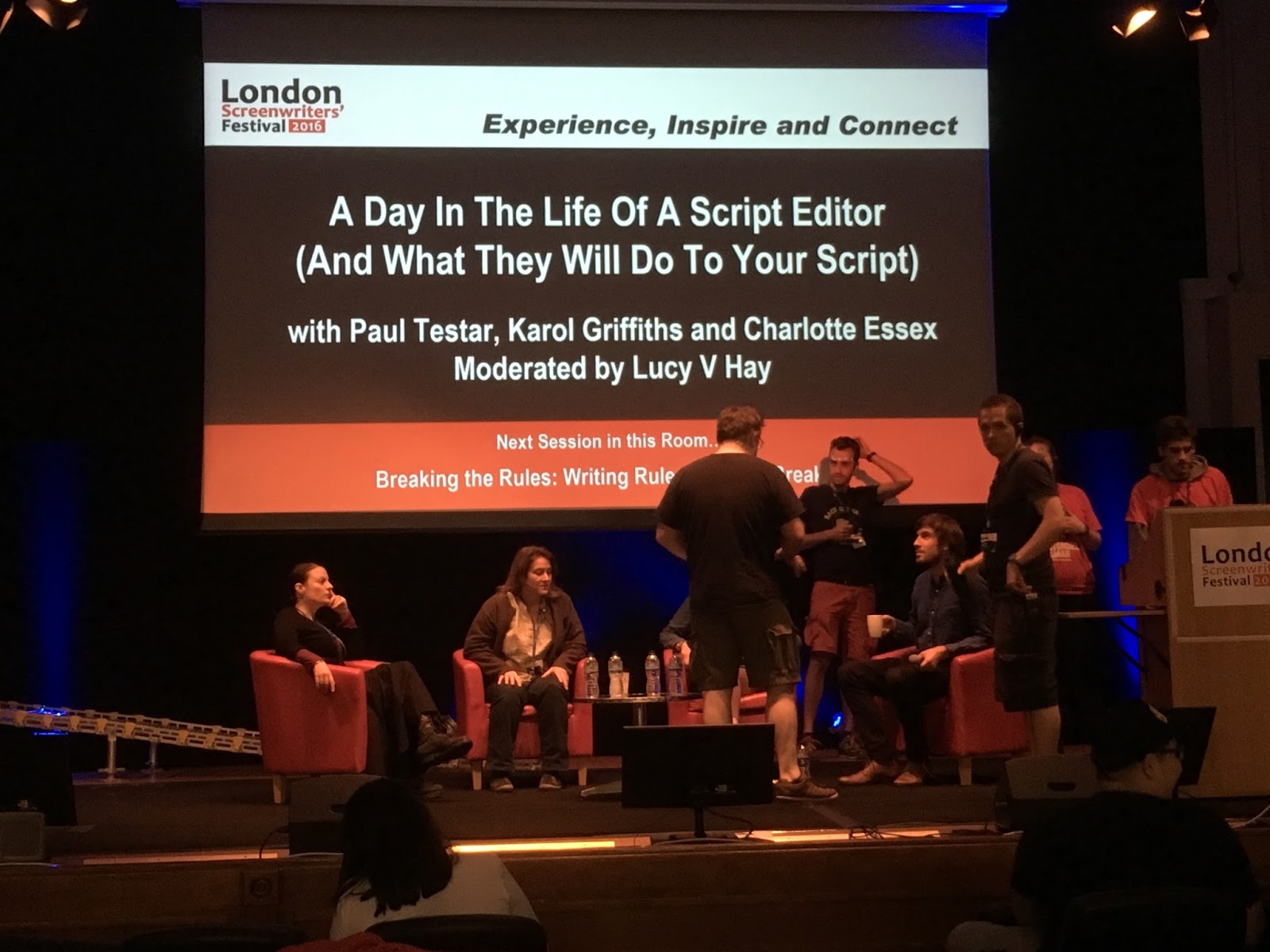
First up - A Day In The Life Of A script Editor. Great session. I really enjoyed listening to each of the speakers and how they dealt with notes and giving them to writers. Always good to get opinions from other points of view. I've had plenty of notes in my time. Some good, some bad, some utterly bonkers, but I've always sat down with the producers/directors/script editors, worked through the notes, come up with alternative suggestions where I can, agreed on changes everyone is happy with and then implemented them in an orderly and stress free manner... which was basically what the above session was about. Remember kiddies, a good script editor is for life, not just for (insert seasonal holiday here).

Second - Subtext; Writing For Depth and Impact. I'm hoping the video for this session is up on LSWF Connect soon, as I'm embarrassed to say the weekend's overload of information took its toll five minutes into this session and I fell asleep. Oops... sorry, Mr Pope, hope I didn't snore too loudly. However, I'm reliably informed it was an excellent session.
My Heroes

FIGHT CLUB!

Brilliant! Brilliant! Brilliant! Brilliant! I want to watch the  film again! I'm planning on doing so with my dear lady wife ASAP. Jim Uhls' commentary was a lot different to Peter Iliff's Point Break approach. Jim kept the majority of his comments focused on the screenplay, the difficulty of adapting a novel (honestly never knew it was an adaptation... I know... book on order), the changes he made and the reasons behind them. Obviously, I can't go into more detail about these, as I'm not allowed to talk about it... shhhhhhhh!

Peter Iliff having a quiet pint or two.
The rest of the day was spent in a blur of networking, swapping cards, promising to email out more screenplays and trying not to drink the right amount of beer to make me an incoherent mess. I can't stress the importance of networking at LSWF enough. It's vital if you want to find work as a writer. Yes, I skipped a few session that day, but you can't beat quality networking.

And so ended this year's festival. I vaguely remember an overly excited guy shouting at me from a stage, telling me I was fucking awesome and to go out into the world and make it a better place... or something. I also vaguely remember standing outside The Globe on Baker Street, drinking beer, promising more people to send them my screenplays and marvelling at the fact Peter Iliff was getting pissed with us. Everything else is a little blurry. Maybe all that lovely information over the weekend was way too much for my grey matter and a bit of it dribbled out of my ears when I wasn't looking?

Happy writing.

Wednesday, September 21, 2016

LSWF 2016 PART 3

SATURDAY 3RD SEPTEMBER

The brilliant Hayley McKenzie
I woke up early and made my way to the Ackland Lounge for Hayley McKenzie's Crime/Mystery/Thriller Script Lab. I learned a great deal in those three hours from 9am to midday, not just from discussing my own project, but also from listening to what Hayley had to say about all the others' projects too.

Specific points I learned in this session:
  • Set the genre expectation.
  • If it's a thriller, is it exciting on the page?
  • If it's a mystery, will we want to spend six hours to find out the answer?
  • A 60-page thriller - turning points every ten minutes, five in all.
  • For a six hour TV serial, you need enough story to last. Most writers try to instinctively stretch their plot rather than put more in.
  • Give your characters more problems, more obstacles to overcome and send them to more places to find more clues.
  • A thriller has to have a threat to life.
  • Thriller - the protagonist is always firefighting the antagonist's plans. What is the antagonist's goal and plan?
  • Don't be afraid to force your antagonist into a corner. Let it happen and then worry about how to get them out afterwards.
  • You must make the tone of the show obvious and consistent. It can't change from episode to episode.
I came out of the session absolutely buzzing (and not because of the coffee), full of ideas and motivated to the maximum. I really wanted to jump on a train, get home and start writing... but I still had part of the weekend left. For me, this was definitely the best session EVER!

Ashley Pharoah - one of my writing heroes.
Next up came Showrunners: Staffing Up The Room and How You Can Get A Seat At The Table.

Again a brilliant session and very informative. It was great to get two differing points of view of what exactly a showrunners' job is and how Kim Revill and the legend that is Ashley Pharoah approached the job.

Then came the script to screen session of Point Break. I bloody love that film so I had been looking forward to its screening all weekend. It didn't disappoint!

Peter Iliff not only kept us entertained with details of how the screenplay evolved from his original idea, but also with his anecdotes of the people he worked with; James Cameron, Partick Swayze, Lori Petty and Tom Sizemore. He was insightful, funny and honest about his work on the film.

Chris Jones introduces the legend that is Peter Iliff.
Peter was actually a revelation over the weekend. Unlike most speakers who quickly return to the green room after their session, Peter hung about all weekend. He could often be seen mixing with fellow writers in the Final Draft Marquee and even came for networking drinks with us at the Globe on Sunday evening. Best of all he was very approachable and was more than happy to chat and answer questions. Peter, as far as I'm concerned, is an absolute legend.

By the time the evening came around I was brain dead from all the information that had been thrown at me. I had earned my bed by the time I finally crawled into it at 11pm.

Happy writing.

Wednesday, September 14, 2016

LSWF 2016 PART 2

FRIDAY 2ND SEPTEMBER

As usual with the festival opening, Chris Jones delivered his high octane, positivity reinforcing, highly motivating speech that had everyone on their feet whooping and hollering, whipping them up into a frenzy without the aid of caffeine or mainlining hard drugs. It was just the wake up I needed after a very long and busy day the day before.

I was totally ready for Pitchfest. Normally I would have prepared the hell out of this day, but because I had been working on a new commissioned feature, had a weeks holiday in Cornwall and spent the Bank Holiday weekend up at my parents, I didn't have any time to prepare. I found it strangely liberating.

I did research the pitch exes who were going to be there and I did decide which projects I was going to pitch to which pitch exes before hand, but I didn't practice my pitches one bit... not even the loglines. In fact, the only real preparation I did for the session was a few quick stretches to warm up and wake up before I entered the room.

Last year I learned all my of loglines off by heart but found when I pitched them they sounded flat and rehearsed. I even got badly tongue tied on one of them and fluffed the pitch magnificently. This year I was calm, relaxed and when I delivered my pitches I delivered them with passion. And I didn't do too bad. Out of the six execs I pitched, I had two positives and one possible and more importantly I had way more fun than last year.


The standout session of the day for me was Getting Commissioned in 2016: What the Broadcasters Want. It's always great to here what broadcasters are looking for and as soon as I got back home after the festival I made sure I followed up on every juicy morsel of information from this session.

And I even got to meet Karl Iglesias, who's book Writing For Emotional Impact I reviewed on my blog back in January 2015. He even signed my copy for me. You can read the blog post here.

Networking drinks. Always fun and a great way to meet many new and exciting people. Cards were swapped, friends made and beers sank. I was hyped at such a good day and could wait for day three.

Happy writing!


Wednesday, September 07, 2016

LSWF 2016 PART 1

WOW!

JUST WOW!

What a weekend. I'm still buzzing. The adrenaline is still pumping. And I'm still striking that superhero pose.
Strike the pose.

Four days of awesomeness that's like mainlining a barrel of caffeine while taking a shot of adrenaline straight to the heart.

I fucking love my tribe.

THURSDAY 1st SEPTEMBER

Up at 5am. On the train at 6.11am. Arrived at Waterloo at 8.16am.

That gave me 44 minutes to navigate London to Regents University for the inaugural Drama Writersroom session with the amazing Danny Brocklehurst. Sweaty, out of breath and lugging two heavy bags I staggered up to reception and found myself arriving at the same time as Danny. I said hello, told him how much I was looking forward to the day and quietly snuck off for a quick caffeine fix.

The Drama Writersroom was amazing, even if the room we were allocated was like an oven and we were wilting within minutes. Being the first ever writersroom we were all, even Danny, a little unsure as to how things should work, but we soon got into our stride. We had been asked to watch Danny's BBC drama Ordinary Lies and come up with a character, a lie, or a true life story we could turn into an episode idea. We all pitched our idea and one was chosen.

What's my name?
The team then set about plotting the episode together. I found this a fascinating exercise. Immediately it was clear who the outspoken characters were in the room and which ones were quieter. I fell somewhere closer to the quieter end of the spectrum, mainly because a 5am start doesn't agree with me. But it didn't matter who was loudest, or who was quietest, everyone's opinion and ideas were listened to and slowly, after much debate, we began to piece together an episode.

There were times when I thought we would never agree. There were times when I thought we had nailed it, only for someone to highlight a gaping hole in our plot. But by the end of the day and with Danny's expert guidance we created a believable and coherent episode outline two of the team pitched to a panel of experts.

I was really proud of what we achieved.

I learnt a lot about myself, my ability as a writer and my place in the world I've chosen to inhabit. All valuable insights.

I hope they do the writersrooms again next year. I'll certainly be applying again. I'd also be happy to sign a waiver so whoever the showrunner is can use the idea created in the session as an episode of their show, while we the creators receive a thank you in the credits. I would get quite a kick out of that.


Other things I learned on Thursday:

  • Danny is an awesome chap and very approachable.
  • Danny drinks a lot of coffee.
  • Everyone loves nacho Pringles.
  • Protein bars are yummy.
  • The halls of residence at the university are actually not that bad and are very handy for staggering exhausted into bed at 10.30pm after consuming several bottles of networking lubricant.
  • I missed my friends.
  • I need to get involved more.
  • I fucking love my job.

Happy writing!

Wednesday, August 24, 2016

THE ELEVEN FUNDAMENTAL QUESTIONS

It's always great to receive positive feedback about the blog and it's especially humbling to be asked to read screenwriting books and review them here. And I've read a lot of books. My bookshelf is full of them.
For me, The 11 Fundamental Questions: A Guide to a Better Screenplay eBook would best suit those new to writing, but can also act as a refresher for the more experienced writer. Presented in a handy, easy to read sections, it makes a great reference tool to checklist your idea before you begin writing and to check you've covered everything when you have finished. Anyway, I'll let it's author Aaron Mendelsohn tell you more about it.
My name is Aaron Mendelsohn. I’m a working, produced screenwriter, a professor of screenwriting at Loyola Marymount University, and an elected officer and lifetime member of the Writers Guild of America West. 
I know there are a lot of screenwriting how-to books out there – I’ve read many of them – but I think I bring a unique perspective and angle to the table.  The perspective is that of a produced, employed writer who has worked consistently in all formats and genres for over 20 years. Currently, I have a feature film, a drama series and an MOW – a rare trifecta – in development at major studios and networks around town. 
As for the unique angle, The 11 Fundamental Questions: A Guide to a Better Screenplay is based on a story-breaking method I came up with a decade ago to help me craft and “stress test” my outlines, pitches and scripts. A couple years ago I started teaching my method in classes and seminars around the world, and the response I got – from professional and emerging writers alike – was “you gotta turn this into a book!” 
So I did.  
Hot off the presses is my first eBook, The 11 Fundamental Questions: A Guide to a Better Screenplay.  Breezy, intuitive and grounded in classic storytelling principles, the book lays out my method in eleven simple steps and offers loads of helpful tips and examples (and at 41 illustrated pages it’s a quick read).  Here’s another nice testimonial – 
"Just when I thought I'd learned everything about writing and running a show, Aaron's Fundamentals method super-charged the way I approach a story. Clear, concise, and practical, this is a must for screenwriters everywhere."
– Chris Brancato, Co-creator, writer and executive producer of the Netflix series "Narcos" 
You can find the eBook at www.11questionsbook.com 
Enjoy the read.

Happy writing!

Wednesday, August 03, 2016

WORKING AROUND THE KIDS AND SCHOOL HOLIDAYS

At a recent writers' event, I was chatting with a lead writer on a continuing drama who was telling me he and his wife had just had a baby. "How the hell do you get any writing done when you have kids?" he asked as he yawned so hard his jaw nearly dislocated.

We're already two weeks into the school holidays and I'm surviving... it can be done. Working from home with the kids on holiday, getting under your feet, asking for snacks every five minutes, begging you to take them up the park, screaming at the top of their eardrum shattering little voices a millimetre from your face demanding attention, moaning that they're bored and constantly trying to kill or maim each other, can be very frustrating for a working writer.

The ideal solution would be that you're earning enough money you're able to hire a childminder to keep them out of your way while you write your masterpiece. However, if you're like me and you don't quite have the money for that and you don't like palming your little terrors off on other people, then the school holidays can be a very daunting time. You're not allowed to tie your children up and stick them in a dark cupboard until school starts again, sell them to gypsies or even use chloroform to keep them quiet... I know, I've checked... apparently, the police and social services get a little cross with you if you try. So with those options restricted I've had to adapt my writing style over the years to ensure I can get my work done, keep the kids occupied and happy and retain my sanity. Here's how I do it.

Goals! What, sticking one in the back of the net for your team? No... just as your characters have goals in your screenplays, you have to have goals in order to survive the holidays without running the risk of a mental breakdown. That's goals for you as well as for your spawn. And there's one rule... we'll come to that in a second.

First things first. As a responsible parent, I will constantly monitor my children, check what they're up to and that they're safe. Dumping them in front of the TV with a bag of sugar is not good parenting. It's the school holidays. The kids are meant to be having fun. They're meant to be having that fun with you. And yes, you're meant to be enjoying it too. They've worked hard all year and now it's time to spend quality time with their parents, doing the crazy shit kids love to do. They're not really interested if you have a deadline. They are not an inconvenience. They are a privilege. They are your responsibility and you have to ensure they are safe and entertained at all times. So... to the rule!

The Rule: My boys know if I'm in my office working, or I'm on my laptop, I am not to be disturbed... under any circumstances... unless it's an emergency, or they've accidently set fire to the dog. Of course, the one rule is not really a rule as it's going to be broken a billion times a day anyway, but as long as the children KNOW and UNDERSTAND the rule, they are aware they run the risk of encountering Shouty Daddy if they interrupt me. You also have to be aware and accept that even with this rule you are going to be disturbed, but hopefully, it will only be for important things and less often. The rule is there to help make things a little easier.

Goals For You:

  • Set yourself writing targets, smaller ones than you would normally, so they are easier to achieve. When my boys were younger I aimed to write in five-minute sprints when they suddenly went quiet. Now they're older I can write for longer periods.
  • Set times for lunch and dinner and stick to them. Routine is a great help.
  • Aim to spend quality time with them for at least two hours a day, either taking them out somewhere special as a treat or enjoying a quick kickabout in the back garden. Whatever you decide to do, make it an adventure... kids love adventure.
  • Stay off your phone and actively enjoy this time with your kids. They'll enjoy it too and then they'll be more likely to leave you alone while you writing.
  • Prepare to be flexible and try and change your routine. Work in your office one day, in the back garden/down the park on your laptop the next.
  • Get your kids to help you prepare lunch, engage them and then sit down and eat with them. Talk to them while you do. Ask them what they would like to do in the afternoon, or the next day and what they enjoyed doing that morning.

Goals For Them:

  • Set up a points system. Give them a point for good behaviour and take away a point for bad behaviour. I start every day by giving them ten points each and then taking off points for bad behaviour during the day. At the end of the week if they've had more positive days than negative ones they get to spend a day or half a day, depending on how busy I am, with me uninterrupted doing exactly what they want to do.
  • Give them tasks to do during the day. At the moment I'm giving my boys one task a day they have to complete between 9am and 10am, which gives me an hour of solid writing every morning. Yesterday's task was to draw an invention. Alex (8) drew a factory that made rainbows. Today's task was to build a rocket out of lego. Dylan (5) built a sports trophy instead.
  • Ration their TV and games devices to two hours a day. I find one hour in the morning and one hour in the afternoon sufficient. If they know how long they have it avoids arguments. Make a big issue of how you're such a great parent when you give them an extra half an hour because they've been really good that day.

The holidays are survivable and you can get writing done with children around. Remember, children are for life, not just for Easter

and happy children will mean you'll get a surprising amount of work done.

Happy writing!

Wednesday, July 20, 2016

BBC TV DRAMA WRITERS' FESTIVAL

On Monday I battled train cancellations, hydrated myself against the heat and dodged many over excited Pokemon Go players to make my way to London and the BBC TV Drama Writers' Festival. And what a brilliant day it was.

As it was my first invite to the festival I wasn't quite sure what to expect, but I was delighted to find it was a much more relaxed environment than other festivals I've been to. The speakers weren't hidden away in a green room and were very approachable. It was just a bunch of writer friends getting together to talk about what they love.

I even got to meet and chat with one of my writing heroes Jed Mercurio, without making a complete gibbering tit of myself... I think.

But the best bit, besides meeting Jed and the free food and wine, was the great advice from the speakers. Because everyone there was an established writer with at least one credit, the speakers didn't need to cover the basics and were much more informative. It was exactly what I needed.

As someone who meticulously plans what he writes, I found it very refreshing, and also a little scary to hear Jed Mercurio talk about how he never knows the ending of the series when he begins the writing process. On series three of LINE OF DUTY, Jed even went back and rewrote the first episode to kill off the planned series villain, played by the brilliant Daniel Mays. When I heard that my writer OCDs screamed at me not to listen anymore and run out of the room. I ignored them and I'm actually going to try and write a pilot episode of something new (without planning it... eek!) and just see where it goes... I may, however, end up dribbling in the corner of the room staring blankly at the wall, mumbling over and over to myself, "there must be a plan, there must be a plan, there must be a plan." We'll see how it goes.

Here are some of the other many valuable bits of advice I took from the day.

  • Unheard Voices: Kay Mellor - Drama is writing about people in society who don't have a voice.
  • Authentic plotting is very sought after. Research is key to this.
  • Pitching: Don't over prepare or you'll lose the punch to your pitch and it will be in danger of sounding flat.
  • Pitching: They want to hear what has driven you to write this story. What is it about the project that makes you passionate?
  • Children's TV: Good drama. International. Push everything further.
  • Returning series: Think the unthinkable and see how that changes things. Be bold.
If you have a TV credit, make sure you apply for next year. It's a brilliant and extremely informative day out.

Happy writing.

Wednesday, June 29, 2016

AM I TOO OLD?

When I hit middle age I got a tattoo, started working out, took up karate, lost a stone and a half and worried far too much about my future and how little of it there was left. My biggest concern was career progression... would I drop dead before I managed to break into TV?
Oscar winner Julian Fellowes -
Photo copyright of AP

My first thought - Was I too old to have a writing career in TV? My second thought - TV producers are mainly looking for young writers eager to learn and easy to mould, right? My third thought - Why do I have hairs growing out of my ears?

Then I read this quote on one of Bangers's (Lucy Hay - Bang2Write) many informative pages:

It’s never too late!

"Bang2writers tell me all the time they fear they’re “running out of time”. But Julian (Fellowes) has a brilliant SECOND career as a screenwriter and only started in his middle age. As he says of GOSFORD PARK, “I was this fat, bald actor nearly fifty, suddenly writing a Hollywood film!” This could be any one of us, IF we keep going and keep ourselves open. 
Lucy Hay, 2016
He'll be sixty-eight this year and he's still writing. Blimey! Suddenly I didn't feel so old. There was hope for my creaking bones and failing memory. Maybe, just maybe my life experience, maturity (ha!) and wisdom were a valuable commodity in the world of TV production.

Then from the depths of my dodgy memory, I recalled a moment last year when a writer came to me asking me to give him feedback on his TV pilot. He had a couple of TV people interested in reading it and wanted to polish it before he sent it off. He showed a great enthusiasm for his work, a willingness to listen to alternative ideas and was open to constructive criticism... and he was seventy-three years old.

So I guess the lesson I learnt here is not to categorise myself. It doesn't matter who you are. It only matters what you write and how you approach your work. Age, race, gender, sexual orientation, etc, are labels. Great writing is great writing and eagerly sought by producers, directors, script editors and development executives alike.

Here's another great link from Bangers... enjoy! - Why It's Never Too Late To Start Writing Your Masterpiece.

Happy writing!

Wednesday, June 01, 2016

PLANNING YOUR STORY

I've always found story planning a pain, something akin to swimming up river wearing a suit made of concrete. That tricky second act is a bugger and often comes back to haunt me like last night's curry.

The way I approach structuring my writing has changed many times over the years and at the moment I'm using a combination of Blake Snyder's Save The Cat beat sheet and blank index cards.

I would always encourage new writers to follow beats and screenplay templates when they first start out, but once you've used them a few times and learned the rules of formatting and structure, it's then possible to be more flexible in your approach. You have to know the rules in order to mess around with them, to break them and create a unique way of telling your story. Even then templates are still helpful.

A few weeks ago I was approached by a new story planning website and asked if I would promote it. Those of you that know me know I don't just pimp any old thing. I don't have ads on my blog or my website for that very reason, so if I do decide to promote a service, site or book it's because I've checked them out thoroughly and I'm satisfied I would happily use them myself.

So it was with pleasure and a great deal of excitement that I dove right into the wonderful (www.storyplanner.com) and gave it a damn good testing. This new site not only gives you access to structure templates like Save the Cat, Syd Field, The Hero's Journey, the Moral Premise and more, but it also gives you more free form ‘Index Card’ style planning tools so you CAN break those rules. There are even templates for those novelists of you out there. How very handy! In fact, there are more tools to help improve your writing than you can shake a stick at, all on one handy website. Even better than that it's a free resource. Here's the official press release below. 
Story Planner offers the largest collection of writing plans online 
Story Planner aims to be the home for story planning online. The new website offers online tools for every aspect of screenplay preparation, from recording new ideas to crafting story structure, developing character outlines, creating log lines and synopsis, or planning scenes. Story Planner gives writers the opportunity to save their notes in project files, and prepare the groundwork for writing a novel, short story or screenplay.
Writers can choose from a range of popular planning methods including Save the Cat, The Hero's Journey, the Moral Premise, Syd Field’s Paradigm and many more. The site also offers a forum, with a facility to share a writing plan for feedback from other writers. Regular free to enter competitions give writers the chance to practise their story structure skills.
 
Joanne Bartley who founded Story Planner said, “I trained as a screenwriter and went from being a writer who wrote entirely instinctively to someone who loved the structure of a writing plan. I think structure plans can guide any writer’s creativity.” 
“I created Story Planner because so many writers use plans from books, character worksheets, or download or create spreadsheet templates, but there was nowhere that offered all of these in one place. So I made the Story Planner site to offer all my favourite plans and give writers the ability to save and edit the plans online.” 
Story Planner has collaborated with many authors and screenwriters to offer their plans online, including Karen Weisner, Graeme Shimmin, Stanley D. Williams (the Moral Premise), Libbie Hawker (Outline your books, for faster, better writing ), Randy Ingermanson (the Snowflake Method), and Save the Cat. 
Joanne said, “I wanted the site to offer a wide range of plans because I know writing methods are personal, so we designed the site so writers can ‘favourite’ their preferred plans ready to use for every project. I intend the site to grow over time, and welcome writers getting in touch with suggestions of new plans to add.”  
Story Planner is free to use, with premium membership offering additional features. 
For full details visit StoryPlanner.com 
Having said that, nothing quite beats the satisfaction of good old fashioned pen and paper.

Happy writing!

Wednesday, May 25, 2016

TURNING REJECTION INTO OPPORTUNITY

The first rough scene.
Last week I wrote about being rejected and how to shrug it off.

WONDERLAND was written a few years ago. The pilot episode has got me through quite a few doors and given me the possibility to pitch face to face with TV development execs. It's still my favourite TV script. So when the BBC Writersroom opened for drama submissions last year, there was only one screenplay I wanted to enter.

It was fantastic to get into the top 3% and equally disappointing to learn I hadn't made it further. I didn't let the rejection get me down. I could have done, but as someone who makes a living from their writing, I couldn't afford to. Besides, the BBC's feedback was heartening as they clearly liked it. It just wasn't for them. Maybe the next one will be. But it was the following line of their email that really caught my eye, "there are moments where the story feels like it could be a surreal graphic novel."


Mad Frank Hattman.
I've always fancied writing a comic or graphic novel and the more I thought about it the more I liked the idea. WONDERLAND would make the perfect graphic novel.

And that's where rejection turned into opportunity. I just happen to know a very talent artist. I sent him the screenplay. He loved it! He drew up some rough samples. He sent them to me. I loved them! And a new project was born.

Obviously, there's a long way to go. We're both very busy so this project will have to be worked on in our spare time. The pilot screenplay will have to be rewritten for a new medium. That means I'll have to research how it's done first. Then the other seven episodes will also have to be written. At the moment they're just brief one paragraph outlines. A webpage will have to be created, set up and promoted the hell out of. This is all long before the glorious day the first ten pages are actually released online.

The point is I could have easily deleted the email and forgotten about it. I could have moved on and continued work on my other projects. I didn't! That's how successful writers survive and thrive, they turn disappointment into something positive.

Happy writing!

Wednesday, May 18, 2016

REJECTION IMPACT

I didn't make the LSWF IMPACT 50... I also wasn't one of the ScreenCraft Fellowship Winners... and my wife won't let me buy a 4K 3D HD TV! You're probably thinking I'm close to taking my own life right about now, eh? WRONG!

Yes, I was disappointed - especially about the TV - but I'm not going to dwell on things. It would be too easy to rage against those who were successful and say, "I hate those smug bastards! I'm gonna hunt them down, find out where they live, wait until they go out, break in their home and do a poop in their cornflakes!" That's one way to deal with things I suppose, but it really is wrong to hate people who achieve what we all work towards. Why?

You have to remember they were us on Monday, fingers crossed in fervent hope, praying the writing gods would be kind, so we shouldn't deny them their success and happiness. After all, they have worked hard, struggled over several years, written and rewritten to get to where they are today... just like us. It was their turn. Think of them as a beacon, proof it is possible, a bloody great big flashing light of hope for all of us. If they can do it, why can't we?

Remember your rejection isn't personal, even if it does feel like it now. They didn't reject you, they just didn't pick your work, and that could have been for any number of practical reasons... it doesn't mean your work is shit. The question you have to ask yourself is, "Was I happy enough with my screenplay to submit it?" If the answer is yes then why are you now questioning its quality?

You might be entering the 'analyzing' stage at this point, asking yourself, "What the hell did I do wrong! What the fuck didn't they like?" Don't go there. The worst thing you can do as a writer is to go through your screenplay and ask yourself what the judges didn't like; what aspect of your screenplay lost you your place? If you start questioning what people don't like about your work, why they rejected it, you can start to loose your creativity. Yes, you need feedback, but blindly trying to guess why you didn't win a competition is only going to screw you up into a tiny little ball of frustration. I've been there. It's not good for you. Or those around you.

Shrug your shoulders, say 'oh well' and move on. There are other competitions, other characters to be created, other screenplays to sweat over. Your life is not over just because you didn't make it this time! There will be other opportunities.

When I learned of my two rejections yesterday I reminded myself I have a new feature commission to get on with. I am not doomed! My writing isn't drivel! I have faced rejection and stared it down. I've pinched the nose of despair, tweaked the nipples of destiny and grabbed my career by the balls. I am 'WRITER', hear me roar! Huzzah!

So if you were disappointed yesterday, shrug it off, dust yourself down and get on with something new. Be fucking awesome!

Oh, and as for that TV... my finger might accidently slip while browsing the Currys website. Just saying..!

Happy writing!

Wednesday, May 11, 2016

THE CHARACTER JIGSAW

One of the obvious writing mistakes I made when starting out was trying to cram as much of my main character's back story into the first act as I could. Schoolboy error.

Like the vast majority of new writers I wanted to get everything in early, to set it all up as quickly as possible so I could get on with my plot. Consequently my first acts were nearly as long as my second acts.

Over the years I've read many books on how to write screenplays, how to structure, plot and where to put what, but the most fascinating books for me were always the ones that concentrated on character. Here are a few things I learnt reading about and developing my own characters.
  • Your main character doesn't need to be good, just interesting.
  • Everyone is flawed no matter how perfect they might seem. Even Jesus had a temper.
  • Everyone has their own wants and desires that drive them. How far is your character willing to go to achieve them and who are they willing to climb over in the process?
  • Look at your plot from every character's point of view. How do they see it? 
  • Not every character learns and grows, some will stay the same.
  • Occasionally your characters will do something completely out of character, something that will add depth to who they are.
But the most important thing I've learnt is that even though you need to know everything you can about your character before you start writing, you don't have to reveal all of that information to make them work, or do them justice. Take the character of Anton in No Country For Old Men. What do we know about him? Not very much. We don't know why he's a killer, or what childhood trauma drove him to become one. His mysteriousness is part of who he is. Ultimately he's a far more interesting character because we don't know.

Character, unlike plot, doesn't need to be tied up or resolved at the end. Characters don't need to be laid bare, their motivations explained, who they are examined under a microscope. The richest characters for me are the ones who are not fully explained, the ones that have an air of mystery.

It's human nature to seek answers to what we don't know or understand. What caused the teenager with a stable family to sacrifice himself as a suicide bomber? What childhood incident caused a successful businessman to attack a taxi driver when he accidently took him to the wrong address? The media delve into the backgrounds of these people in an attempt to find answers, to justify why these people might do such things, to explain away what would otherwise be just too terrifying to contemplate. If there's an answer, an explanation, it's easier to deal with and accept.

For a writer this can be dangerous. We already know to get into scenes late and get out early, so why do we try and explain every facet of our characters and why they do what they do? Whether you love or hate Christopher Nolan's The Dark Knight the Joker Heath Ledger portrayed was exactly the kind of character we all fear. He had no backstory, no motivation for who he was and he was a more terrifying character because of it; "Some men just want to watch the world burn."

So treat your character like a jigsaw. Don't try and complete him/her in the first act. Take your time. Feed the audience a piece here and there. Those little reveals of character throughout the screenplay add new, interesting layers to the characters you create and can add another dimension to the story you are telling.

And remember, with every jigsaw puzzle there's always at least one piece that goes missing, the one that drops down the side of the sofa, gets chewed by the kids or the dog, or the one sucked up in the vacuum cleaner.

Happy writing!

Wednesday, May 04, 2016

ENCOURAGING CHILDREN TO WRITE

On our last visit to my parents', my mother gave my eldest son Alex a leaflet for a short story competition. The challenge; between 750 and 1000 words on any subject he chose.

My son is very competitive. He loves football, karate and pretty much any sport. He excels at school and is in the top group for everything. However, he isn't very creative and it's a constant battle to tear him away from the games on his tablet. "This will be a challenge," I thought.

So I sat him down and tried to explain about good characterisation, the three act structure, and many other helpful writing tips. Five minutes in he crinkled his nose and looked up at me.

"Daaaaaad!"

"What's up," I said?

"I just want to get on and write it."

So I shut up and let him.

It took him nearly four weeks to write his story, writing and rewriting, asking me what I thought, erasing bits he didn't like and not once did he moan he couldn't do it. His enthusiasm was inspiring. It reminded me of how I feel when I'm in the zone. It was joyous to watch him as he beavered away in the corner of our living room, head down typing away at the laptop, occasionally staring into space while his little grey cells searched for the perfect word to compliment his story. I was so proud.

Alex finally finished his story last night, just before bed. He asked me to read it. I have to admit it was pretty good for an eight-year-old. Of course, now his entry is in I'll probably be asked about forty times a day if he's won it yet, at least until the results are finally published... but that's just Alex.

What's important here is he loved the process, had fun with it and worked hard to get those pesky elusive words down on the page. I hope his story will be the first of many... but that's just me.

Maybe one day he'll be writing his own screenplays.

Happy writing!